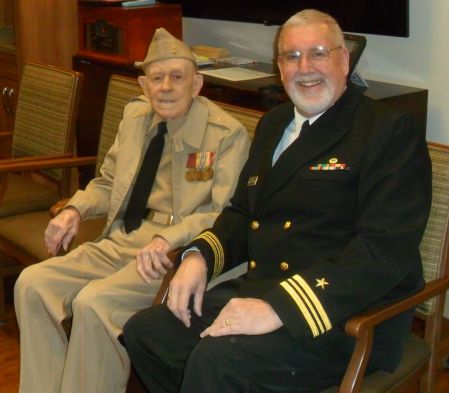
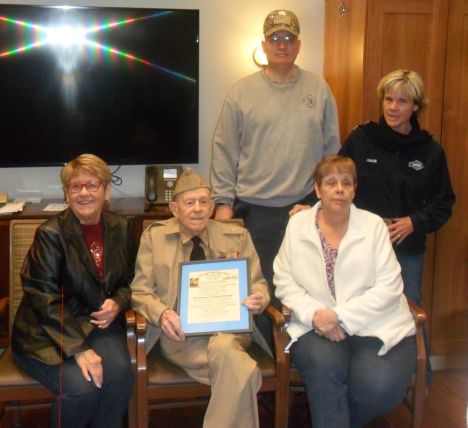
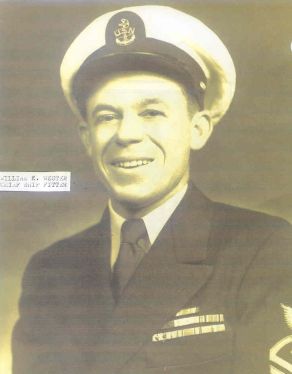
William E. Wester USS Salt Lake City CA25 Chief Ship Fitter 1940-1946 |
|
USS SLC...Officer...William E. Wester, CSF, USN
 William E. Wester passed away on Aug. 2nd, 2019 at the age of 103
UPDATE August 5th, 2019
June 19th, 2006 Before Dec. 7th, 1941, the USS Salt Lake City was at sea on maneuvers and war games. Our planes were launched for observation. when they came back in, landing in the ocean along side the ship and hoisted aboard, their 30 caliber machine guns were removed from the planes and taken to the aviation ordnance work shop to be checked and cleaned, which was in the 4th Division space aft. I was working on the deck top side to finish the job I was working at. I needed some gear or a different tool. At that time I was assigned to the 4th Div. and our gear locker where we kept our tools and etc. were just forward and above the ordnance work shop. I climbed the ladder to the gear locker and was standing on the steps reaching inside to find the gear I wanted. The Sailor working on the guns aft, on the other side of the bulkhead, pulled slide back on one of the guns. The chamber had a round of ammunition in it. When he let of of the slide the gun fired, drilling a hole through the 5/8 inch steel bulkhead and the slug that came out of the bulkhead shattered into small pieces. I got steel pieces in my face, belly and arms and one piece of steel about 1/4 inch long and 1/8 inch wide went 2 1/2 inches up my arm cutting a blood vessel. I left a trail of blood from the gear locker forward to Sick Bay. Days later after the maneuvers was over and we got back to Pearl Harbor, the piece of steel was removed from my arm at the Naval Hospital. They checked the place where I was standing and said the bullet had gone between my legs. If I had been one step lower on the ladder the bullet would have gone through my groin or belly. I feel like I'm one of the lucky sailors aboard the SLC. There were so many close calls that a few more inches or feet could have cost me my life. I feel like a higher power was watching out for me. That it wasn't my time to die. Take the time a storm was coming up. I was outside the ship fitters shop in the passageway trying to secure the loose acetylene and oxygen bottles. A huge rolling wave came across the wee deck and down through the passageway, catching me and the bottles. The water completely filled the passageway from deck to the overhead. As the wave rolled me head over heels through the passage way, I could feel these bottles rolling with the water around me. The bottles went out to sea, but somehow, the life lines around the side of the ship must have caught me and as the water passed over me, dropping me in the gutter around the side of the ship. As my lungs cleared and I could start breathing again, I realized where I was. From where I was laying in the gutter, with one arm over the side, the other one on the deck and face down in the gutter, if the water had rolled me one more time, I would have been out in the ocean, lost at sea. At Okinawa, when the Marines landed there April 1st, the USS SLC was one of the many ships lined up off the beach firing in shells over the heads of the Marines and soldiers landing there. One of the Marines was my uncle, Henry Neil Wester. We spent three months there. I remember the Kamikazes suicide planes. They would come in early in the mornings if they weren't shot down and crash on one of our ships. One early morning I was checking the water tight and gas fitting in the after part of the ship's doors, hatches and port holes to make sure they were all dogged down. I open a door on the starboard side aft leading to the main deck to side. As I was closing the door, dogging it down, I looked aft and there was this plane, somehow it had got through and flying low, right above the water between the Salt Lake and the cruiser following behind us. As it came near the stern of our ship it seemed to be coming straight at me and I thought it was going to crash the ship. It was almost at the stern when it went straight up and in a circle upside down toward the ship following us, missing the starboard side on the bridge, the plane crashed in a gun tub, starboard side aft of the bridge. From the impact of the crash I could see what looked like bodies, arms and legs flying through the air around the gun tub. William E. Wester #7 in "R" Division, 1943 SLC Deck Logs Oct. 1943 Dec. 1943 Attended the following SLC Reunions: 1999 2001 2006 2008 |
|
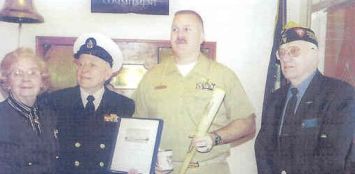
October of 2004 William E. & Kathleen Wester presented a book with the story of the USS SLC CA25 to A. B. Gorski, Commanding Officer or the Naval Reserve Center & Bob Devore, for the library. |
|
|
October 11th, 2004 Department of the Navy Naval Reserve Center Louisville, Kentucky From: Commanding Officer, Naval Reserve Center, Louisville To: William E. Wester, USN (Ret) Subject: Letter of Appreciation 1. On behalf of the Naval Reserve Center Louisville, I want to extend to you my heartfelt gratitude for the contributions you made recently. The photographs will soon grace the passageways and administrative spaces of NRC Louisville. They will serve as constant reminders of the historical events of the USS Salt Lake City CA25. This Naval heritage donation will inspire our young Sailors to strive for a greater good, remind our seasoned Sailors of the glories of past cruises, and ultimately serve as a testament to the Honor, Courage and Commitment of the men and women which make up the World's Greatest Navy. On behalf of the men and women of Naval Reserve Center Louisville and those shipmates deployed across the globe in support of Operations Enduring Freedom and Iraqi Freedom, please accept my personal thanks for your contributions and patriotic spirit. 2. On behalf of Naval Reserve Center Louisville, Bravo Zulu! A. B. Gorski |
|
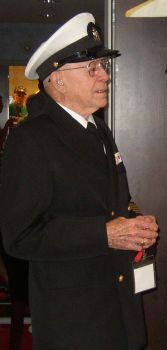
William E. Wester at the 19th Reunion of the SLC Assoc. Tulsa, OK. June, 2006 |
|
The address of this page is wester.htm
Send Questions, Comments or Report Problems to Website Curator, Sandy Eskew Return to SLC Main Index for Email Address ©Copyright 
|